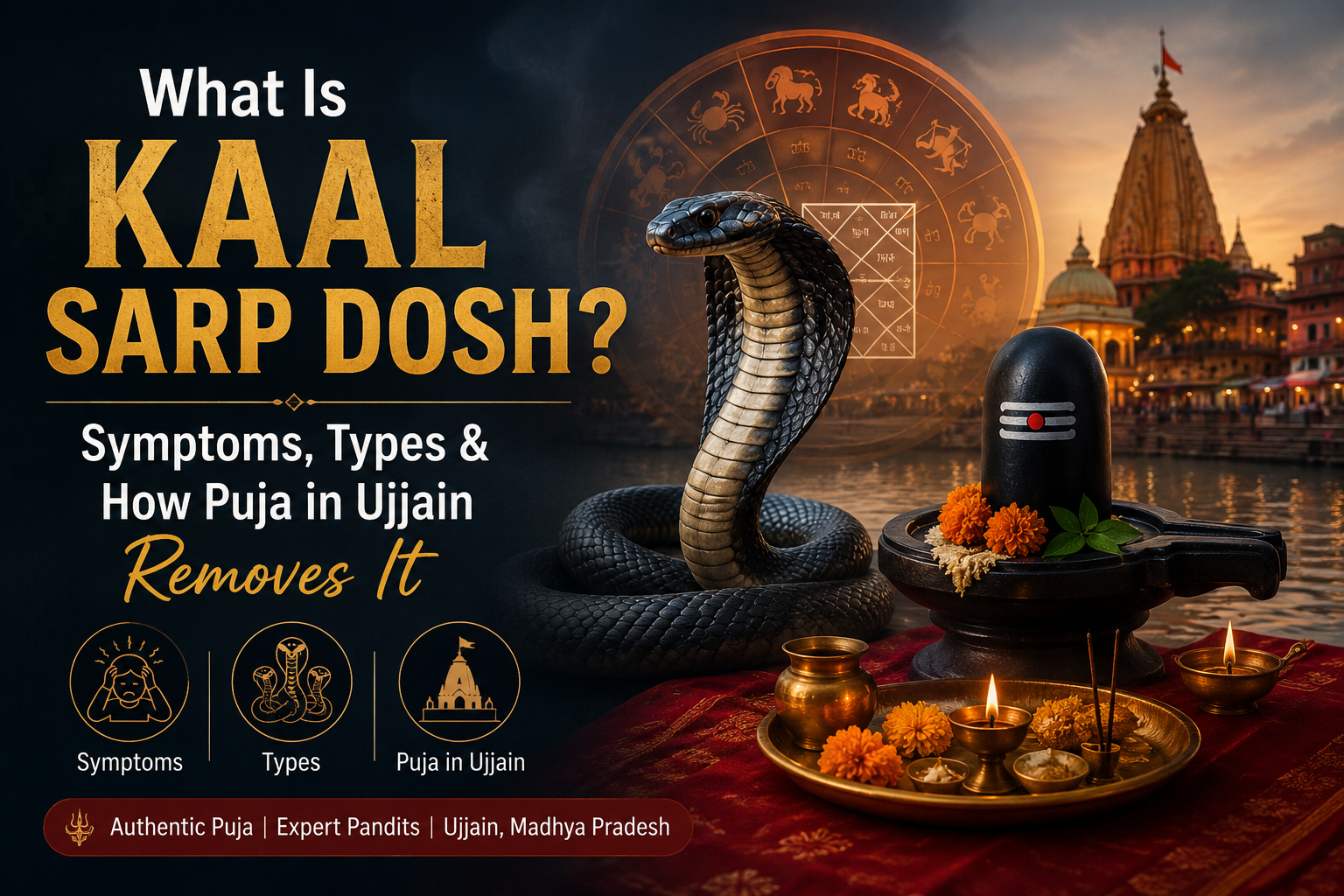
f you have ever sat across from an astrologer and heard the words “your kundli has Kaal Sarp Dosh,” you already know how unsettling that can feel. It sounds serious, mostly because it’s talked about in hushed tones, and much of the information about it online is exaggerated. Let’s clear that up, and look at why so many families choose a Kaalsarp Dosh Puja in Ujjain to address it.
What Is Kaal Sarp Dosh?
In Vedic astrology, every planet sits somewhere in your birth chart, and two of them aren’t real planets at all — Rahu and Ketu, the north and south lunar nodes, always exactly opposite each other. Kaal Sarp Dosh forms when all seven other planets — Sun, Moon, Mars, Mercury, Jupiter, Venus and Saturn — get trapped between Rahu on one side and Ketu on the other, unable to “escape” that axis.
Picture a snake (Sarp) coiled around the other planets, holding them in place — that’s the imagery ancient texts use, and where the name comes from. It doesn’t mean your life is cursed. It means certain planetary energies are held back or delayed, and that delay tends to show up in fairly recognizable ways.
Common Symptoms of Kaal Sarp Dosh
Not everyone with this dosh experiences every symptom, and severity depends on which of the twelve types you have. That said, people commonly report:
- Repeated delays in marriage, career growth or childbirth, even when everything “looks right” on paper
- A persistent feeling of being held back despite hard work
- Recurring anxiety, disturbed sleep or vivid, uneasy dreams
- Sudden obstacles in legal matters, litigation or property deals
- Unexplained financial ups and downs
- Health issues that don’t respond well to normal treatment
If several of these sound familiar and your astrologer has already confirmed Rahu-Ketu axis involvement, it’s worth understanding the type before deciding on remedies.
The 12 Types of Kaal Sarp Dosh
The dosh is classified based on which house Rahu occupies at birth — Anant, Kulik, Vasuki, Shankhpal, Padma, Mahapadma, Takshak, Karkotak, Shankhachur, Ghatak, Vishdhar and Sheshnag. Each type touches a different area of life: some affect career and authority, others touch marriage, and a few are linked more to health and mental peace. This is why a generic, one-size-fits-all puja rarely gives lasting results — the rituals need to match your exact type.
Why Ujjain Is the Right Place for This Puja
Ujjain isn’t just another city that happens to offer this puja — it’s Mahakal Nagari, home to one of the twelve Jyotirlingas and considered the most powerful seat of Rahu-Ketu energy in the entire country. Many Vedic scholars believe that Rahu and Ketu pujas performed near the Shipra river and under the influence of Mahakaleshwar carry a spiritual weight that’s hard to replicate elsewhere. This is a big reason devotees travel from across India and abroad specifically for Kaal Sarp Dosh Puja here rather than getting it done locally.
How the Puja Is Performed
A proper Kaalsarp Dosh Puja is not a quick five-minute ritual. It typically involves Sankalp (a formal resolve), detailed Rahu-Ketu mantra jaap, havan with specific samagri, and an abhishek — all carried out according to your exact type of dosh and birth details. Our experienced Vedic Pandits in Ujjain follow the traditional Guru Parampara method, so nothing is shortened or generalized just to fit a fixed time slot.
Getting Started
If you suspect Kaal Sarp Dosh is behind some of the repeated obstacles in your life, the first step is simple — share your birth details and let a qualified Pandit confirm the type and severity before recommending a puja date. You can contact us directly to check available dates, understand the complete procedure, and get honest guidance on whether this puja is truly needed in your case. There’s no benefit in performing a ritual you don’t actually require — and every benefit in doing the right one, properly, in the right place.